HPJ WELCOME Fall 2026 IPHE vol 6 iss 2
Abstract
Welcome from the Co-Editors-in-Chief
We would like to welcome you to Volume 6, Issue 2 of the Healthy Populations Journal (HPJ); Art, Health and Ways of Knowing. For this issue, we sought submissions from graduate level scholars and community members to bring poetry, visual art, and academic commentary and research together.
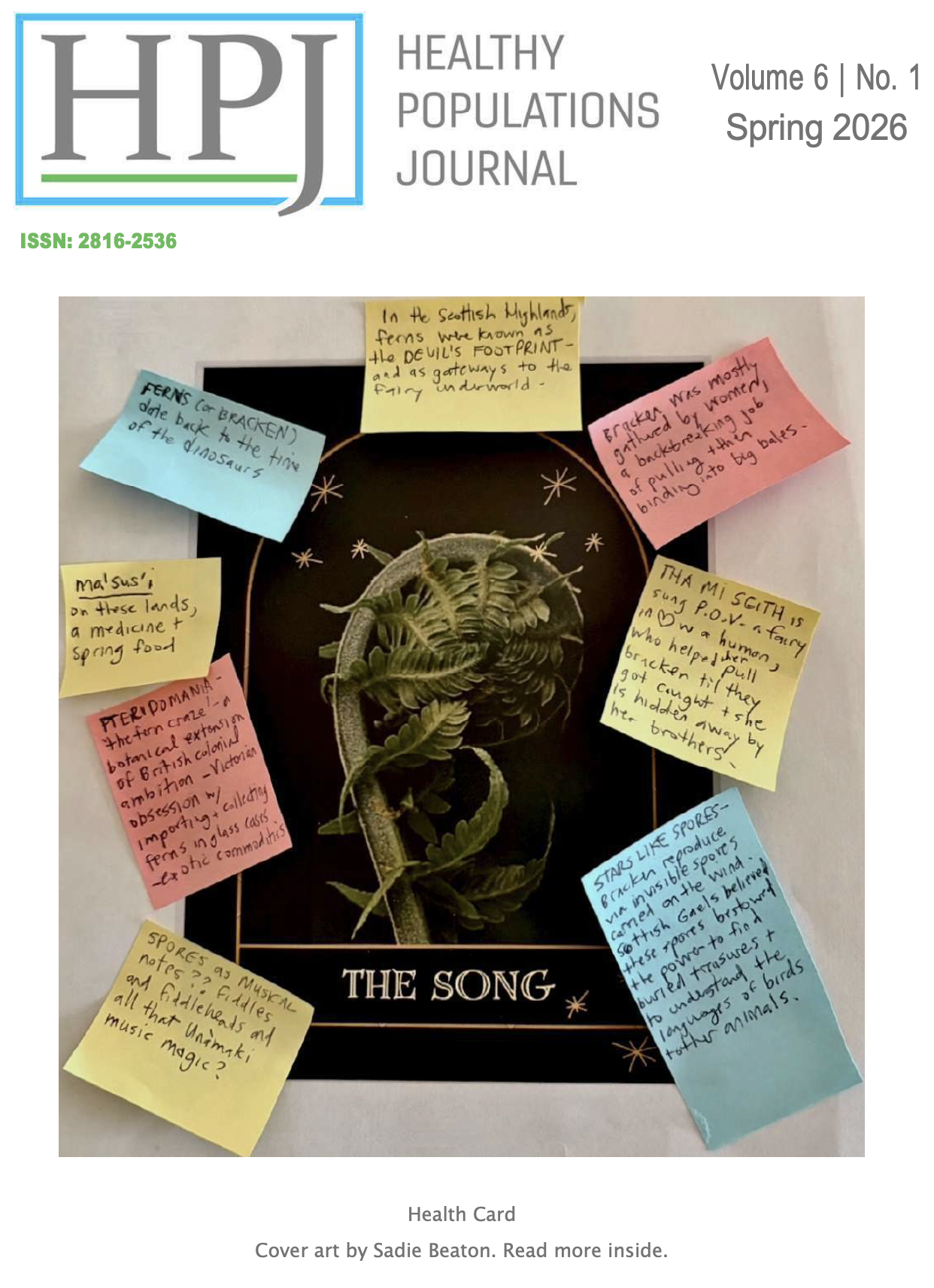
Of note is the artwork featured on the cover titled Health Card by Sadie Beaton. It is part of their Interdisciplinary PhD work exploring ways to reimagine settler-colonial narratives that challenge narratives of discovery, empty land, and other fictions that erase the presence of Indigenous peoples long before colonization on Turtle Island. The cover extends into the first artistic piece, a Micro-fiction by Beaton that weaves their own settler history into their project of reimagining. The art of being seen: Visual expression in dementia care by Henen Bijoy, a nursing student explores their relationship to the intersection of dementia care and art as a tool to express emotions and memories. Get ready to enjoy some delicious brushstrokes that will get you thinking. Matthews et al. draw from poetry, not as a luxury, as a way to highlight Black pain, Black voices: A poetic reckoning in youth pain care. This amazing and thoughtful creation extends from a larger research project and is an example of culturally competent narrative research that packs a punch. Next is a collection of Untitled poetry from Natalie Forsyth. A community poet and writer, Forsyth uses writing to help them explore their inner world demonstrating how creative expression through poetry can support greater understanding of the self and the other within and beyond clinical settings. Rand et al. present a commentary titled For art’s sake, for health’s sake: Centering creativity in Indigenous health research knowledge sharing. This collectively written commentary highlights how art acts as more than not-data, helping to bridge communities. Rand et al. demonstrate how when health researchers embrace being in relations, long term health equity relationships can take different shapes, allowing for new potentials. Sarah E. Norris book ends this issue with their article, Autoethnography, arts-based inquiry, and disability justice: Critical reflections on embodied knowledge. Using their own poetry to extend their critical reflection and literature review to an active showing of how she envisions autoethnography as a tool for enacting disability justice, Norris’s article is a top-notch, well-rounded introduction for graduate students and seasoned researchers interested in learning more about autoethnography, art and disability and climate justice.
HPJ would not be possible without the guidance from the HPJ Editorial Board Members and funding for copy-editing from the Faculty of Health, Faculty of Dentistry and the Faculty of Medicine at Dalhousie University.
Thank you and we hope that you will feast your eyes and senses on volume 6, issue 2.
Downloads
Published
Issue
Section
License
Copyright (c) 2026 Healthy Populations Journal

This work is licensed under a Creative Commons Attribution-NonCommercial 4.0 International License.
The journal aims to reduce barriers to publishing and sharing research and inequalities to accessing information.This journal provides immediate open access to its content on the principle that making research freely available to the public supports a greater global exchange of knowledge. The open-access nature of the journal means that there will be no charge for authors or readers to use the journal. The journal has a Creative Commons Attribution Non-Commercial (CCBYNC) attribution which allows the author (and others) to share and distribute their full-text article in other public domains, such as Google Scholar or Research Gate.